Did you know?
Casinos must report all gambling winnings over $1,200 to the IRS using a W-2G form[1].
That means every jackpot hit on a slot machine, every big poker win, and every high-stakes payout must be carefully tracked and reported to comply with U.S. tax laws.
Beyond taxes, casinos must also track every dollar that moves in and out of their business, not just for profitability but also to comply with anti-money laundering (AML) regulations.
Under the Bank Secrecy Act, casinos that handle more than $1 million in annual revenue must report suspicious transactions and large cash deposits exceeding $10,000 to the Financial Crimes Enforcement Network (FinCEN)[2].
Now, imagine the sheer volume of transactions an online casino handles daily, from player winnings to deposits, payouts, and operational expenses. Without a solid online casino accounting system, keeping track of taxable winnings and ensuring compliance with IRS regulations would be nearly impossible.
That’s why financial statements are essential for getting a holistic picture of your casino’s financial health while helping you stay compliant and ensuring long-term profitability.
Below are the key financial statements every casino needs.
1. Income statement
Also known as the profit and loss (P&L) statement, the income statement provides a detailed breakdown of revenue, expenses, and net profit or loss over a specific period, typically monthly, quarterly, or annually.
In online casino accounting, this statement is essential for understanding how much money the business is making, where costs are highest, and whether operations are sustainable in the long run.
The income statement consists of three key sections:
1. Revenue
This is the total earnings from wagers, fees, and non-gaming sources. Casinos do not recognize player deposits as revenue, and it is only counted once a bet is placed and settled (accrual accounting).
Gross Gaming Revenue (GGR)
Gross Gaming Revenue (GGR) is the casino’s total earnings from wagers before deducting expenses. It is calculated as:
GGR = total bets – total winnings paid
Net Gaming Revenue (NGR)
Net Gaming Revenue (NGR) is the amount left after deducting costs like promotional expenses, bonuses, and affiliate commissions. It provides a more accurate measure of a casino’s profitability than GGR.
NGR = GGR – bonuses – affiliate payouts – other costs
Beyond gaming revenue, some casinos also generate additional income from:
- VIP membership programs and subscriptions
- In-game purchases
- Advertising and brand partnerships
Tracking revenue sources separately allows casino owners to evaluate which areas contribute most to profitability and adjust business strategies accordingly.
2. Expenses
While revenue figures may look promising, profitability depends on how well costs are managed. Casinos face several direct and indirect expenses that impact their bottom line.
Direct costs (cost of revenue)
These are expenses directly tied to gaming operations.
- Payouts to players
- Software and licensing fees
- Affiliate commissions and marketing costs
- Payment processing fees
Managing these costs efficiently ensures that promotional strategies and player acquisition efforts are financially sustainable.
Operating expenses
Beyond gaming-related costs, casinos must also account for operational expenses, including:
- Salaries and wages for all employees
- Server hosting, cybersecurity, and IT infrastructure
- Compliance costs related to anti-money laundering (AML) and tax reporting
- Administrative expenses such as rent (for land-based operations) and business insurance
These expenses can quickly add up, making it essential for casino owners to review them regularly and cut unnecessary costs.
3. Profitability
This is what remains after deducting all expenses. The income statement ultimately determines whether a casino is operating at a profit or loss.
EBITDA (Earnings Before Interest, Taxes, Depreciation, and Amortization)
EBITDA provides a clearer picture of a casino’s profitability before considering financing and tax expenses. It is calculated as:
EBITDA = Revenue – cost of revenue – operating expenses
A positive EBITDA indicates that the casino is generating enough revenue to cover operational costs, while a negative EBITDA suggests financial inefficiencies.
Net profit
Net profit is the final figure that remains after all financial deductions, including taxes and loan repayments. It is the most important profitability metric, calculated as:
Net Profit = EBITDA – interest – depreciation – taxes
If net profit is negative, it signals potential financial risks, such as excessive spending or high player payouts relative to revenue.
Below is a sample income statement of Bet at Home online casino that contains all the essential elements discussed above.

Source: Bet at Home[3]
2. Balance sheet
An income statement tells you whether your casino is making a profit, but it doesn’t show the full financial picture. That’s where the balance sheet comes in.
The balance sheet is a snapshot of your casino’s financial position at a given point in time. It details what your business owns (assets), what it owes (liabilities), and what’s left over for owners (equity).
This financial statement is essential for tracking liquidity, managing risk, and ensuring that player funds are appropriately accounted for and protected.
The balance sheet follows the fundamental accounting equation:
Assets = Liabilities + Equity
1. Assets
Assets represent everything of value the casino controls or expects to benefit from in the future. They are typically divided into current assets and non-current assets.
Current assets (short-term holdings)
These are assets that can be easily converted into cash within a year.
- Cash & cash equivalents like bank account balances and highly liquid investments.
- Player receivables
- Prepaid expenses for services like software licensing, advertising, or regulatory fees.
Non-current assets (long-term investments)
These are assets the casino holds for long-term use rather than immediate cash flow.
- Gaming equipment & software licenses
- Intangible assets like brand reputation, gaming licenses, and customer databases
A financially stable casino will have enough current assets to cover short-term liabilities while also investing in long-term growth.
2. Liabilities
Liabilities represent the casino’s financial obligations, including loans, accounts payable, and player funds held for withdrawal. Just like assets, they are divided into current and non-current liabilities.
Current liabilities (short-term debts)
These are financial obligations due within a year.
- Player deposits & withdrawals
- Accounts payable for game software, security services, and operational expenses.
- Taxes payable
Non-current liabilities (long-term debts)
These are obligations that extend beyond a year.
- Bank loans & credit facilities
- Deferred revenue from prepaid services, such as VIP membership fees or annual software licenses, which must be recognized over time.
To run a successful casino, you must ensure that liabilities don’t outweigh assets to prevent financial instability and liquidity issues.
3. Equity
Equity represents the ownership value remaining after all liabilities are subtracted from assets. It indicates how much of the business belongs to the owners or shareholders.
Equity = Assets – Liabilities
Equity typically includes:
- Retained earnings: Profits reinvested into the business instead of being distributed.
- Owner/shareholder investments: Initial and additional investments made into the casino.
- Stockholder equity (for public casinos): The value held by external investors.
A positive equity balance means the casino owns more than it owes, signaling financial strength. Negative equity, on the other hand, could indicate debt problems or poor financial management.
Here’s a sample balance sheet from the same casino:


Also read: Balance sheet metrics small business owners must know
3. Cash flow statement
A casino can appear profitable on paper but still struggle with cash shortages if money isn’t moving efficiently. That’s why, alongside the income statement and balance sheet, the cash flow statement is also equally essential.
A cash flow report provides a detailed breakdown of how cash is moving in and out of the casino over a specific period. It answers a more immediate question: Does the casino have enough cash on hand to operate smoothly?
The statement is divided into three sections, each covering a different aspect of how cash is generated and spent.
1. Cash flow from operating activities
Operating activities cover the core financial transactions that keep the casino running day-to-day. This includes:
- Player deposits & wagers
- Payouts to players
- Gaming revenue & fees from the casino’s house edge, rake fees (for poker rooms), and tournament entries.
- Operational expenses like employee salaries, rent, utilities, and marketing costs.
- Tax payments & compliance costs
A positive operating cash flow means the casino’s daily operations are generating more cash than they’re spending, which is a sign of financial stability.
A negative cash flow from operations may indicate that the casino is paying out more than it’s making, which could lead to liquidity problems.
2. Cash flow from investing activities
Investing activities focus on major financial decisions that impact the casino’s future. This section tracks cash used for or generated from investments such as:
- Purchasing gaming equipment or software licenses
- Buying or upgrading property
- Acquiring or selling assets
A casino with regular investing activities may look like it’s actively planning for growth, but excessive cash outflows in this section without matching revenue growth could indicate overinvestment or poor financial planning.
3. Cash flow from financing activities
This section tracks how the casino raises and repays money from outside sources, including:
- Loans & credit lines
- Debt repayments
- Shareholder distributions (paying dividends or returning capital to investors)
Casinos with strong financial management will have a healthy balance between external funding and profitability. Too much borrowing without sufficient revenue can increase financial risk.
Sample cash flow report:
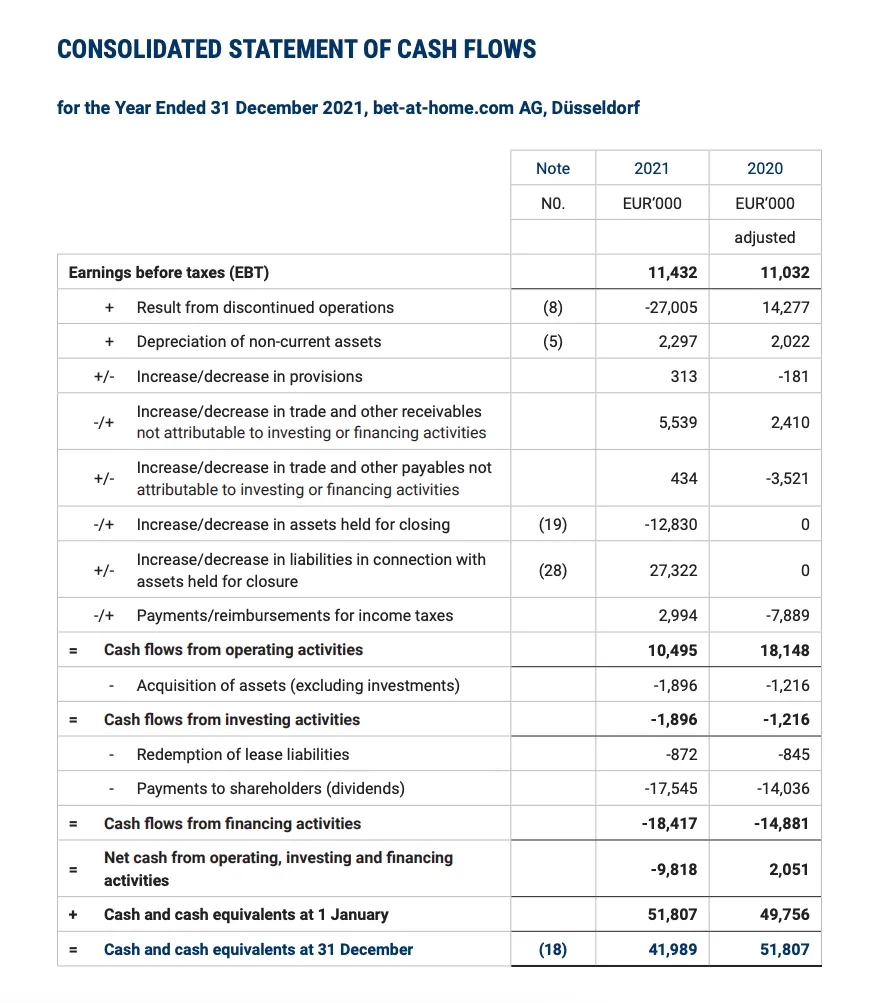
This cash flow statement is slightly different from standard formats because it starts with Earnings Before Taxes (EBT) instead of net income and integrates discontinued operations within operating activities. It also includes closure-related assets and liabilities, which are not commonly shown in typical cash flow statements.
Additionally, the investing and financing sections are simplified, only listing asset acquisitions, lease payments, and dividends without details on debt or equity financing.
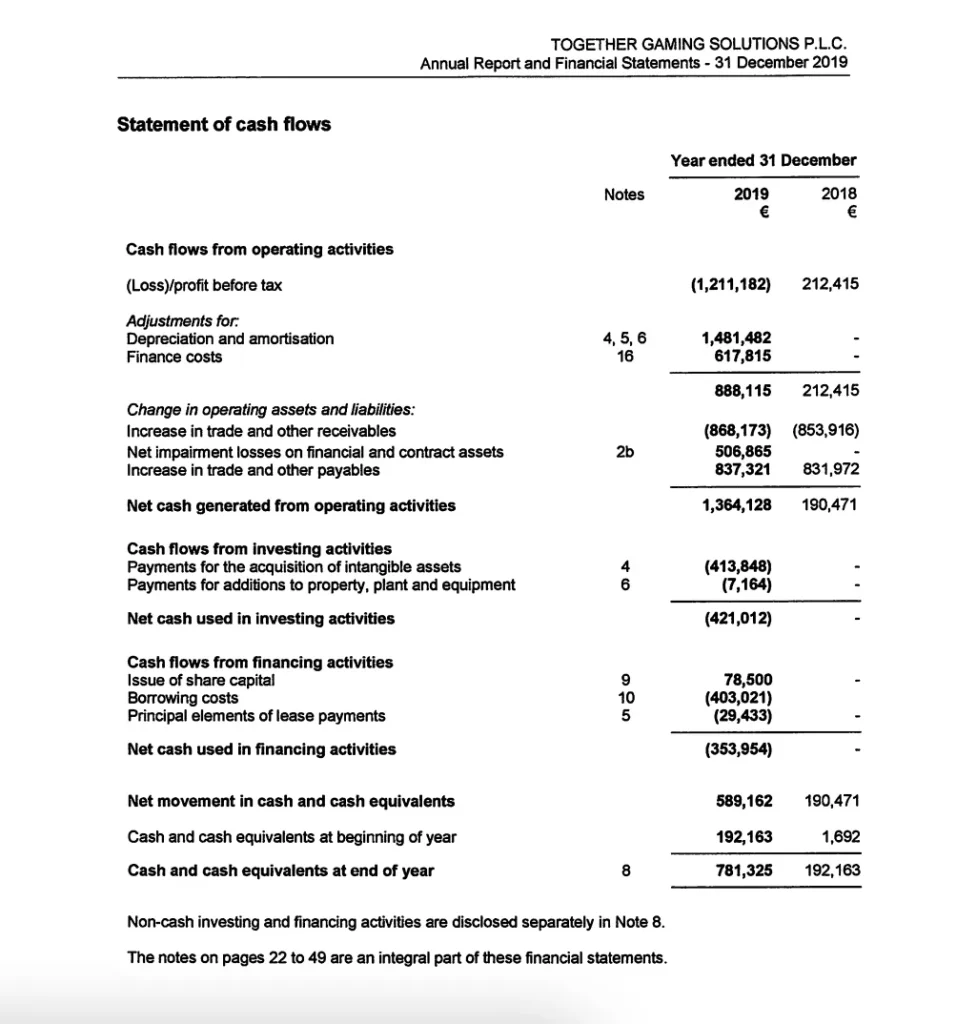
Here’s another statement of cash flows from Together Gaming Solutions that follows the standard format:
Also read: Why is a cash flow statement important?
Supporting financial statements a casino must prepare
In addition to the key financial statements discussed above, you must also prepare several supporting financial reports to ensure compliance, manage operations, and track financial performance accurately.
These reports provide deeper insights into specific areas of the business, such as payroll, player transactions, outstanding debts, and regulatory filings.
1. Statement of retained earnings
The statement of retained earnings tracks changes in the casino’s accumulated profits over a specific period. It shows how much of the casino’s net income is reinvested into the business and how much is paid out to owners or shareholders.
For online casinos, this statement is essential for understanding financial growth, ensuring sustainability, and making informed decisions about reinvestment and profit distribution.
This statement includes:
- Beginning retained earnings – The profit carried over from the previous period.
- Net income – The total earnings from casino operations after expenses and taxes. This figure comes from the income statement.
- Dividends or owner withdrawals – The portion of profits distributed to shareholders or withdrawn by owners.
- Ending retained earnings – The remaining profit available for reinvestment.
A positive retained earnings balance means the casino is growing and reinvesting profits, while a declining balance may signal financial strain or excessive payouts.
2. Schedule of receivables
Casinos often extend credit to high-stakes players, allowing them to gamble without upfront cash. The schedule of receivables tracks:
- Outstanding casino markers (credit extended to players)
- Uncollected funds from third-party payment processors
- Pending withdrawals and chargebacks
3. Tax filings & compliance reports
Casinos must submit various tax and regulatory reports to government agencies, ensuring proper taxation and compliance with anti-money laundering (AML) laws. Key reports include:
- Gaming tax reports
- Withholding tax reports (W-2G Forms) – submitted for player winnings over $1,200.
- Currency Transaction Reports (CTR) – required for cash transactions over $10,000 (AML compliance).
- Suspicious Activity Reports (SAR) – filed when a casino detects potential fraud or money laundering activities.
Also read: Tax brackets 2023-2024: How much business tax you owe
4. Statement of changes in stockholders’ equity
This is a formal financial statement that tracks changes in equity accounts over a specific period (monthly, quarterly, or annually).
It shows how the company’s ownership value has changed due to retained earnings, dividends, stock issuances, or repurchases. It is typically included in annual reports and required for publicly traded companies or businesses with multiple investors.
5. Notes to consolidated financial statements
The notes to consolidated financial statements provide additional details that supplement the online casino’s financial reports, ensuring transparency and compliance with digital gaming regulations.
They clarify accounting policies, financial assumptions, and any disclosures necessary for a complete understanding of the casino’s financial position.
These notes also help investors, auditors, and regulators understand how financial figures are calculated and any potential risks that could impact the casino’s operations.
For online casinos, these notes typically include:
- Accounting policies – Revenue recognition, player deposit treatment, and expense reporting.
- Breakdown of financial figures – Details on gaming revenue, promotional expenses, and outstanding receivables.
- Regulatory compliance – Gaming license requirements, anti-money laundering (AML) measures, and tax reporting.
- Contingent liabilities & risks – Pending lawsuits, contractual obligations, and market risks.
- Asset valuation & depreciation – Methods used to calculate depreciation on gaming equipment, property, and software licenses.
- Related party transactions – Financial dealings with parent companies, subsidiaries, or key stakeholders.
- Subsequent events – Significant events occurring after the reporting period that may impact financial performance.
The bottom line
Online casino accounting requires careful tracking, accurate categorization, and strict compliance to avoid financial and legal risks. Casinos must follow regulations like AML compliance, tax withholding on winnings (W-2G), and large cash transaction reporting (CTR, SARs).
Mistakes like mislabeling transactions or failing to track cash flow properly can lead to serious problems. That’s why it’s best to work with a professional Las Vegas bookkeeping service that understands the industry.
At CoCountant, we provide casino bookkeeping services to keep Las Vegas casinos compliant and profitable. We ensure accurate revenue tracking, proper expense classification, and hassle-free tax reporting so your casino runs smoothly.
We handle everything from GGR and NGR tracking to AML compliance, W-2G filings, and large cash transaction reporting (CTR, SARs), ensuring you meet all regulatory requirements. Our expert bookkeepers provide hands-on oversight, keeping your financials organized, tax-ready, and fully compliant.
FAQs
How does bookkeeping help casinos manage player promotions and bonuses?
Proper bookkeeping categorizes these expenses separately to ensure they are deducted from Net Gaming Revenue (NGR), preventing inflated earnings reports and helping optimize marketing budgets.
What’s the biggest financial mistake casinos make?
One major mistake is mismanaging cash flow, focusing only on revenue without monitoring liquidity. A casino can appear profitable on paper but still struggle to cover payouts, taxes, and operational expenses. Strong bookkeeping ensures cash flow is tracked properly, preventing financial shortfalls.
How often should casinos prepare financial statements?
Casinos typically prepare monthly, quarterly, and annual financial statements. Monthly reports help track cash flow, revenue trends, and expenses, while quarterly and annual statements are used for tax filings, investor reporting, and compliance with gaming regulators.
Disclaimer
Reference links
- https://www.irs.gov/pub/irs-pdf/iw2g.pdf
- https://alessa.com/blog/casino-anti-money-laundering-regulations/
- https://www.bet-at-home.ag/wp-content/uploads/pdfs/IR%20Download/2022-04-04/EN/Annual_Report_2021_EN.pdff