Form 1040, or the U.S. Individual Income Tax Return, is a key document when filing federal income tax returns with the IRS. This form helps you report your total income for the year and determine how much of that income is taxable after applying tax credits and deductions.
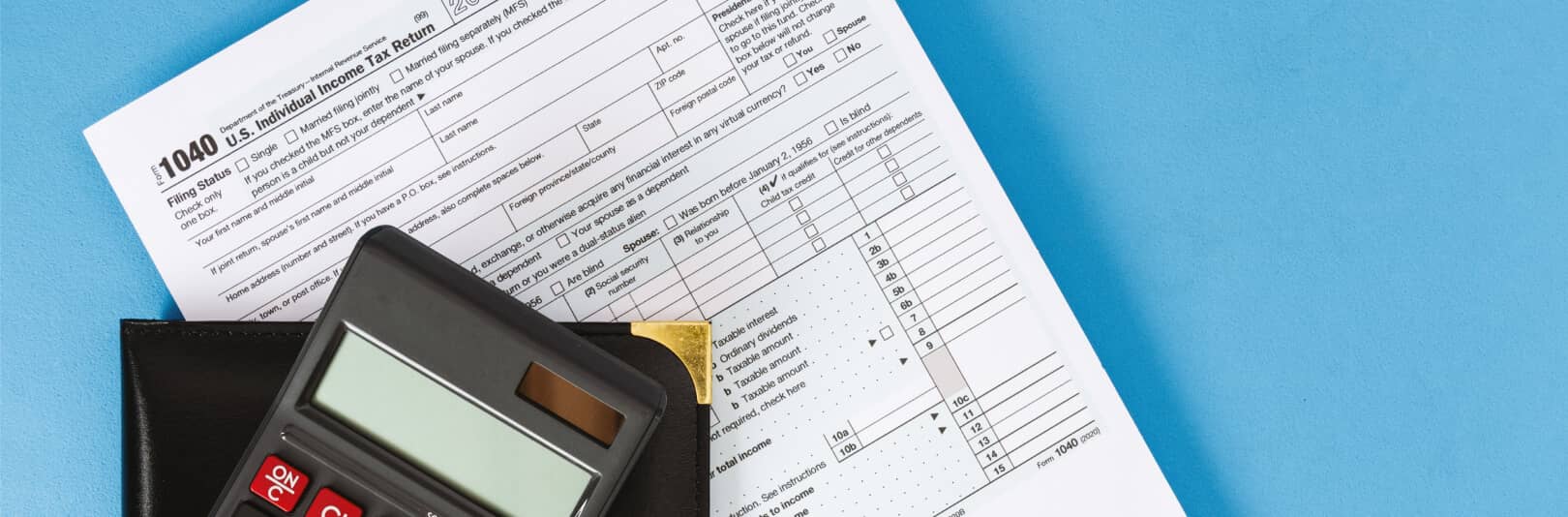
After years of yearning to leave your 9 to 5, you’ve finally taken the leap to pursue the venture of your dreams and launch your own business.
While many things in your life change, one constant remains: Form 1040, the mother of all tax forms. Even as a small business owner, this form continues to be the backbone of your tax filings, just like it used to be when you were a full-time employee. Do you know what else it continues to be? A pain.
Completing Tax Form 1040 takes an average of 12 hours, says the IRS; non-business taxpayers spend about 8 hours, while those tackling Schedule C, E, or F can clock in around 21 hours. It’s like having a part-time gig just to file your taxes!
Did you know?
Albert Einstein is often quoted as having said, “The hardest thing in the world to understand is the income tax.”
So whether you were once reporting wages and are now tracking business income, the process of filling this hard-to-read form may seem rather lengthy.
Don’t worry if you’re not familiar with every line and box—this blog serves as your refreshed guide to understanding and filing Form 1040 as a new entrepreneur, ensuring you’re equipped to handle your taxes.
What is Form 1040?
Form 1040, or the U.S. Individual Income Tax Return, is a key document when filing federal income tax returns with the IRS. This form helps you report your total income for the year and determine how much of that income is taxable after applying tax credits and deductions. Essentially, Form 1040 calculates whether you owe more taxes or are due for a refund.
The form is divided into sections where you report your income and deductions. Depending on the type of income you have, you might need to attach additional forms, known as schedules, to provide more details. For instance, if you have income from investments or rental properties, specific schedules will be necessary.
Form 1040 is not just for individuals employed by an organization but also for those running small businesses as well as freelancers and contractors. This form can account for various sources of income and more complex tax situations, making it useful for independent contractors or freelancers.
Even if you don’t need to file taxes, consider submitting a Form 1040 anyway. This way, you avoid missing out on potential refunds or other benefits that you might be entitled to.
Who needs to file Form 1040?
Almost everyone earning in the US needs to file Form 1040. It doesn’t matter whether you work for someone as an employee, are self-employed, run a business, or even if your means of income are just investments.
The three categories that determine whether or not you need to file Form 1040 are:
- Your filing status
- Your age
- Your gross income
| Filing status | Age at the end of the tax year | Minimum gross income |
| Single | Under 65 65 or older |
$12,200 $13,850 |
| Married filing jointly | Under 65 (both spouses) 65 or older (one spouse) 65 or older (both spouses) |
$24,400 $25,700 $27,000 |
| Married filing separately | Any age | $5 |
| Head of household | Under 65 65 or older |
$18,350 $20,000 |
| Qualifying widow(er) | Under 65 65 or older |
$24,400 $25,700 |
Note that if you have net earnings of at least $400 from self-employment, you must file a tax return. This requirement means that most independent contractors, freelancers, and business owners need to file Form 1040, even if they don’t meet the gross income thresholds mentioned above.
Children and dependents may not need to file their own tax return if they can be claimed as dependents. However, for 2023, a dependent must file a Form 1040 if:
- Their unearned income is over $1,250 (increasing to $1,300 in 2024) but less than $12,500 (rising to $13,000 in 2024).
- Their earned income exceeds $13,850 (increasing to $14,600 in 2024).
- Their gross income meets specific thresholds.
These filing requirements differ slightly for single dependents compared to married dependents.
In addition, there are specific situations where an individual must file Form 1040, regardless of their income or dependency status. These situations include, but are not limited to:
- Owing special taxes such as the alternative minimum tax
- Receiving distributions from Health Savings Accounts (HSAs) or other health accounts
- Having net earnings from self-employment of at least $400
- Meeting income threshold limits for wages earned from a church
These requirements ensure that even those with unique tax situations are compliant with IRS regulations.
For more detailed guidance on who needs to file, refer to Charts A, B, and C in the instructions for Form 1040.[1]
Why are there different versions of the 1040 form?
You might have seen different variations of this form and wondered why they exist. The IRS has tailored these forms to address the specific needs and situations of taxpayers.
Here are the multiple variations of the 1040 form:
1- Form 1040: This is the one the majority of taxpayers will use to report income, determine their tax for the year, and calculate any refund or additional tax owed.
2- Form 1040-SR: This version is designed for senior taxpayers (age 65 and older). Form 1040-SR is nearly identical to Form 1040, but it is printed using a larger font and includes a chart for determining the taxpayer’s standard deduction.
3- Form 1040-NR: Certain nonresident aliens or their representatives need to file this form, including:
- Those engaged in trade or business in the United States
- Representatives of a deceased person who would have had to file a Form 1040-NR
- Those representing an estate or trust that had to file a 1040-NR
4- Form 1040 PR: Self-employed persons in Puerto Rico use Form 1040 (PR) to compute self-employment tax.sons in Puerto Rico use Form 1040 (PR) to compute self-employment tax.
5- Form 1040-X: This form is for taxpayers who need to make amendments to their tax return after previously filing a Form 1040. If you make a mistake or forget to include something on your 1040 form, you can use Form 1040-X to correct it.
6- Form 1040-V: This form is a payment voucher that you send along with your payment if you owe money on your Form 1040 or 1040-NR.
7- Form 1040-ES: This form is used to calculate and pay estimated quarterly taxes. It’s for income not subject to withholding, like earnings from self-employment, interest, dividends, and rents. It can also apply to unemployment compensation, pension income, and the taxable portion of Social Security benefits.
8- Form 1040 SS: This form is for residents of the U.S. Virgin Islands, Guam, American Samoa, the Commonwealth of the Northern Mariana Islands, and Puerto Rico who don’t need to file a U.S. income tax return. One of its jobs is to report net earnings from self-employment (SE) to the U.S. and pay SE tax if needed. The Social Security Administration (SSA) uses this info to calculate your social security benefits. SE tax applies regardless of your age, even if you’re already enjoying those social security or Medicare benefits. Because taxes never take a break!
How to file Form 1040
Form 1040 is available on the IRS website[2] and consists of two pages that need to be filled out. You can either mail it in or e-file it.
Yes, it’s just two pages long, but with 14 references to other schedules and forms, and another 14 prompts to check the ‘instructions,’ it’s like a scavenger hunt where the prize is more paperwork.
What you need to file Form 1040
When completing the form, you’ll need to provide:
- Name
- Address
- Filing status
- Social Security number
- Statement of income such as W-2 or 1099
- Proof of tax credit or tax deductions
- Copies of past tax returns
- Bank account number and routing number (used for any eligible refund)
- Information about your spouse and dependents.
Steps to fill out the form
Once you have gathered all the required documents, it’s time to fill out the form. Here’s a step-by-step guide to help you in the process:
- Provide your information: At the top of Form 1040, you’ll enter basic personal details, including your filing status and dependents.
- Calculate taxable income: In the income section, you report various types of income, including wages, salary, taxable interest, capital gains, pensions, Social Security benefits, and other income sources. Note that recent tax legislation has eliminated many deductions, such as unreimbursed employee expenses, tax-preparation fees, and job-related moving costs (except for active-duty military personnel). The form will guide you through reporting all your income and claiming any deductions. This helps determine your taxable income, which is what you’ll be taxed on.
- Determine your tax liability: Towards the end of the form, you’ll calculate the amount of tax you owe, subtract any credits you’re eligible for, and account for any tax already paid through withholding from your paychecks throughout the year.
- Check if you’ve overpaid or owe more: Finally, Form 1040 helps you figure out if the taxes you’ve prepaid through withholdings or estimated payments cover what you owe. If they do, you might get a refund; if not, you’ll find out how much you need to pay.
Form 1040 uses a “building block” approach, allowing taxpayers to add only the necessary schedules to their tax returns. Depending on your situation, you might need to file one or more of six supplemental schedules in addition to the standard ones for items like business income or loss. This is typically necessary if you’re claiming tax credits or owe additional taxes. However, many individual taxpayers only need to file Form 1040 without any additional schedules.
In the next section, we will discuss these schedules in detail.
What are the different schedules used with Form 1040?
Although Form 1040 is relatively concise, it requires various schedules, or supplementary forms, to detail specific financial items. Here are the primary schedules you might need to use:
Schedule 1
This schedule covers additional sources of income and adjustments to income. You might need to fill out Schedule 1 for:
- Alimony received
- Gains or losses from selling business property
- Unemployment compensation
- Business income
- Educator expenses
- Student loan interest deduction
- Contributions to health savings accounts
Schedule 2
This form is for reporting extra taxes and is divided into two sections:
The first section includes the alternative minimum tax and repayments of excess premium tax credits for health insurance obtained through the marketplace.
The second section covers taxes such as self-employment tax, unreported Social Security and Medicare tax, additional tax on IRAs and other tax-favored accounts, household employment taxes, repayment of the first-time homebuyer credit, additional Medicare tax, and net investment income tax.
Schedule 3
This schedule is for claiming additional credits and payments and is also divided into two parts:
- Refundable credits
- Non-refundable credits
Some examples of credits reported on Schedule 3 include those for child and dependent care expenses, residential energy improvements, tax overpayments from previous years, and excess Social Security tax previously paid.
Schedule A
This common form is used to enter all itemized deductions. These can include medical and dental expenses, mortgage interest, state and local taxes, charitable donations, and casualty and theft losses.
Schedule B
This form is used to report interest and dividend income that is greater than $1,500. If your interest and dividend income is under that amount, you can enter it directly on Form 1040, Lines 2 and 3.
Schedule C
This form is for reporting profit or loss from a business. It’s typically used by independent contractors, freelancers, and owners of sole proprietorships or single-member LLCs.
Schedule D
This form is used to report taxable income from the sale or exchange of a capital asset. This could include gains from an exchange or an involuntary conversion. Schedule D is also used to report capital gain distributions not otherwise reported on Form 1040, as well as nonbusiness bad debts.
Schedule E
If you have income or losses from rental real estate, royalties, partnerships, S corporations, estates, trusts, REMICs, or other pass-through entities, you will report those amounts on this form.
Schedule EIC (Earned Income Credit)
Schedule EIC is unique among tax schedules. While the earned income credit itself is calculated separately, this schedule is used to provide the IRS with information about your qualifying children. You will need to include your child’s name, Social Security number, birth year, relationship to you, and residency status. Unlike other schedules, the information from Schedule EIC is not directly entered into Form 1040 but is used to support your claim for the earned income credit.
Schedule F
Farmers use this form to report their farming income and expenses.
Schedule H
If you have household employees, like a nanny or caretaker, this form is for reporting and paying Social Security and Medicare taxes.
Schedule J
Farmers and fishermen can use this form to average their taxable income over the previous three years, which can help manage tax liability.
Schedule R
This form is used to claim the credit for the elderly or disabled.
Schedule SE
This form calculates self-employment tax for business owners or independent contractors who earned at least $400 in profit.
Form 8812
Use this form to claim the Child Tax Credit and Credit for Other Dependents. If your total child tax credit amount exceeds the tax you owe for the year, this form will help you determine the refundable portion of the credit.
The bottom line
Whether you’re a freelancer, independent contractor, or small business owner, knowing the filing requirements of IRS Form 1040 and understanding its different schedules can be daunting.
With CoCountant, rest assured that your tax filings will be handled accurately and submitted on time, avoiding penalties and ensuring peace of mind. From federal to state and local taxes, we manage all aspects of your tax filings, including income, sales, and use taxes.
Learn all about our tax advisory and filing services here, or speak to an expert directly.
FAQs
Is Form 1040 the same as a W-2?
No, Form 1040 is not the same as a W-2. Form 1040 is used by taxpayers to file their annual federal income tax returns with the IRS. It reports income, deductions, and credits to calculate the tax owed or the refund due. On the other hand, a W-2 is a form that employers provide to employees, detailing the employee’s earnings and the amount of taxes withheld from their paycheck throughout the year. The information on a W-2 is used to fill out Form 1040.
What is the difference between a 1040 and a 1099?
Form 1040 is the standard form used by individuals to file their annual federal income tax returns. It reports various types of income, deductions, and credits. A 1099 form, however, is used to report different types of income that are not covered by a W-2, such as income earned as an independent contractor, interest and dividend income, and other miscellaneous income. Taxpayers use the information from their 1099 forms to complete their Form 1040.
What about 1040EZ and 1040A?
Form 1040EZ and Form 1040A were simplified versions of the standard Form 1040, designed for taxpayers with straightforward tax situations. Form 1040EZ was for individuals with no dependents and a simple income structure, while Form 1040A allowed for more types of income and deductions but was still simpler than the full Form 1040. However, both forms have been discontinued since the 2018 tax year, and all taxpayers now use the redesigned Form 1040.
What is Form 1040 filing deadline?
The filing deadline for Form 1040 is typically April 15th of each year. If April 15th falls on a weekend or a legal holiday, the deadline is extended to the next business day. Taxpayers can request an extension to file their return by October 15th, but any taxes owed are still due by the original April deadline to avoid interest and penalties.