Startups need more than tidy ledgers. You need a partner who runs a disciplined close, connects actuals to the plan, and helps you make faster calls with confidence. If you are comparing Bookkeeper360 with other options, this guide lays out the best alternatives and makes a clear recommendation. It follows the same structure and voice you approved, with CoCountant positioned as the leading choice for controller-led bookkeeping and practical FP&A support.
CoCountant exists for founders who want clean books, investor-ready reporting, and comprehensive financial management without building a big internal team.
Why consider a Bookkeeper360 alternative
Teams switch when the month-end takes too long, reporting leaves leadership with more questions than answers, or the cost does not match the level of oversight. If you are feeling any of that, evaluate providers on a few non-negotiables.
Use this checklist:
- Pricing clarity and scalability. You should understand the base, the add-ons, and the path from seed to growth without surprise costs.
- Controller oversight. A controller shortens the close, tightens reconciliations, and prepares you for diligence.
- Reporting and FP&A. You need GAAP financials, clear KPIs, and a live connection to your operating plan.
- Ecosystem fit. Confirm smooth connections with payroll, payments, subscriptions, revenue recognition, and any inventory needs.
- Onboarding effort. Ask how many hours your team will spend getting to a stable, repeatable close.
The 5 best Bookkeeper360 alternatives for startups and growing businesses
1) CoCountant

Overview
CoCountant brings controller‑led bookkeeping together with practical FP&A so your leadership team gets the whole picture, not just monthly statements. Month‑end runs on a disciplined close, reconciliations are tight, and documentation is audit‑ready. GAAP financials come with KPI narratives and variance explanations that boards can act on. The model is built for startups and growth companies that want clarity, speed, and investor‑level confidence.
Pricing
Starting from $160 per month.
Pros
- Policy and process ownership that shortens month‑end
- Investor‑grade reporting and decision‑focused analysis
- Forecasts, scenarios, and runway views included
- Clean documentation and reliable reconciliations
- Scales across funding rounds without early ERP pressure
Cons
- Not a fit for teams seeking a software‑only approach
Best for
Startups and growth companies that want comprehensive financial management without building a large internal team.
2) Pilot

Overview
Pilot focuses on startup‑oriented bookkeeping and is comfortable with SaaS tools, subscription metrics, and common growth‑stage workflows. Teams appreciate the quick onboarding and consistent monthly cadence, which makes closing the books predictable. The service is designed to keep the basics tight while offering an upgrade path as needs get more complex. If you want familiar SaaS‑friendly routines with minimal founder lift, Pilot is an easy add to the shortlist.
Pricing
Essentials starts at $99 per month; Core from $299 per month, with higher‑tier and custom plans available for added complexity and advisory.
Pros
- Quick ramp‑up and standardized SaaS workflows
- Reliable monthly bookkeeping with light founder involvement
Cons
- Controller oversight and FP&A generally live on higher tiers
- Custom reporting may require additional scope
Best for
Early‑stage teams that want a dependable monthly close and a clear upgrade path.
3) Bookkeeper.com

Overview
Bookkeeper.com packages bookkeeping and payroll so founders can simplify vendor management and keep operations steady. The service emphasizes consistent month‑end deliverables and routine compliance tasks that small businesses rely on. While controller‑level guidance tends to be custom, the one‑provider model reduces coordination headaches. If you want bookkeeping and payroll under one roof, this is a pragmatic option.
Pricing
Uses a calculator rather than fixed public tiers; typical small‑business costs land in the low‑ to mid‑hundreds per month depending on accounts, volume, payroll, and add‑ons.
Pros
- One‑vendor convenience for books and payroll
- Steady, predictable month‑end routines
Cons
- Controller depth and GAAP nuance are usually custom
- FP&A requires a separate engagement
Best for
Founders who want bookkeeping and payroll handled together with minimal vendor sprawl.
4) Fincent

Overview
Fincent offers a modern, responsive experience with a clean monthly portal that keeps founders in the loop without demanding heavy time. The service keeps day‑to‑day bookkeeping current and packages results in an approachable, visual format. It’s a low‑friction way to stay organized while you grow, with the option to layer capabilities as complexity increases. For teams that value speed, visibility, and tidy handoffs, it’s a strong contender.
Pricing
Public pricing begins at $189 per month for Basic and $429 per month for Power; custom plans available for broader scope.
Pros
- Fast onboarding and founder‑friendly visibility
- Keeps the books current with minimal overhead
Cons
- Complex consolidations and GAAP topics may need extra support
- FP&A and scenario planning typically add‑ons
Best for
Companies that want a tidy monthly view and a lightweight bookkeeping handoff.
5) Decimal
Overview
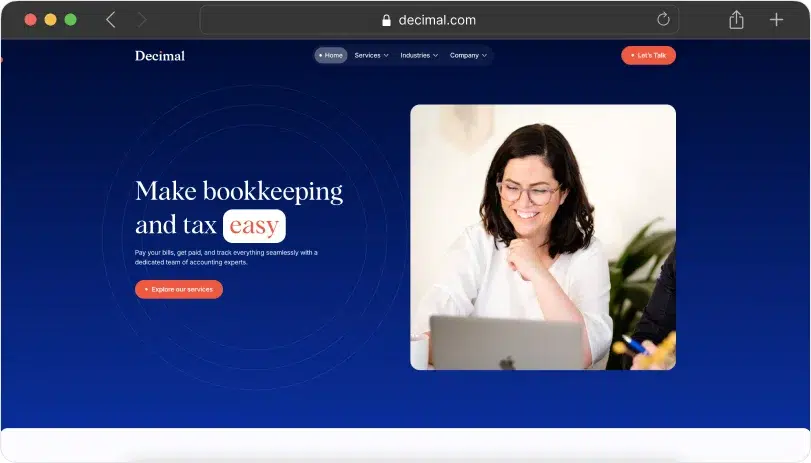
Decimal is built around standardized, documented workflows that make recurring finance tasks predictable. The playbook approach reduces variance month to month and helps teams create a stable operating rhythm. It’s a good fit when you want consistent execution without designing internal processes from scratch. You can add strategy over time, although controller‑level guidance usually sits outside core packages.
Pricing
Plans commonly published at $299, $449, and $679 per month by scope; fractional CFO services are custom.
Pros
- Documented processes that reduce variability
- Operational consistency and repeatability month over month
Cons
- Controller guidance may be limited by plan
- Strategic finance usually requires add‑ons
Best for
Teams that want predictable, playbook‑driven bookkeeping with room to layer on strategy later.
Comparison table
| Solution | Category | Best for | Controller or CFO oversight |
| CoCountant | Outsourced accounting service | Startups and growth companies seeking comprehensive financial management | Included, controller‑led |
| Pilot | Outsourced bookkeeping | Early‑stage teams wanting dependable monthly closes | Limited, varies by tier |
| Bookkeeper.com | Outsourced bookkeeping + payroll | Founders who want steady books and payroll together | Custom or limited by plan |
| Fincent | Outsourced bookkeeping | Companies wanting a low‑friction monthly view | Limited in base scope |
| Decimal | Outsourced bookkeeping | Teams that value predictable, playbook‑driven execution | Limited, varies by plan |
How to choose the right alternative
Think in horizons. Focus on the next 12 to 18 months and pick the model that supports that plan.
- Define your close targets. Weekly reconciliations, day-by-day tasks, and a clear month-end calendar.
- Map your integrations. Payroll, payments, subscriptions, and revenue recognition all need to flow reliably.
- Decide on oversight. If audits or investor updates cause stress, bring in controller leadership.
- Align on FP&A. Your forecast should tie to actuals, with scenarios that mirror your decisions on hiring, pricing, and growth.
- Calculate total cost. Include software, services, add-ons, and the internal time you will spend to maintain the process.
Final recommendation: CoCountant
CoCountant delivers controller-led bookkeeping paired with real FP&A support. You get the rigor of a controller, the hygiene of a well-run close, and reporting your board actually uses. Accountants handle the day-to-day. A controller enforces policy and review. FP&A ties actuals to forecasts and scenarios. You get clarity, compliance, and decision-ready numbers.
What you get with CoCountant
- Controller leadership that sets policy, owns close discipline, and improves audit readiness
- Investor-grade reporting that includes GAAP statements, KPI narratives, and budget versus actuals
- FP&A partnership for forecasting, scenarios, and cash runway planning
- Compliance-first documentation that keeps diligence calm and complete
- A growth path that stretches your stack further before an ERP becomes necessary
Ideal for SaaS startups, venture-backed companies, and tech-enabled SMBs that want accuracy, oversight, and planning support in one relationship. Not for do-it-yourself teams seeking software only.
FAQs
How is CoCountant different from Bookkeeper360
CoCountant centers the engagement on controller leadership and FP&A. You get policy, process, and planning in one place. That means faster closes and investor-ready reporting without juggling multiple vendors.
Do I need a controller at my stage
If your month-end slips, if board updates take too long, or if you are preparing for diligence, controller oversight raises the standard quickly and pays off when you need to prove accuracy.
What does onboarding look like with CoCountant
We align your chart of accounts, define policies, and set the close calendar. We connect systems, clean historical data where needed, and run a short parallel close before going live to stabilize the process.
Can CoCountant work with my existing tools
Yes. We connect to common payroll, payments, and subscription platforms and meet you where you are on the accounting system.
When does a startup graduate to an ERP
Move when multi-entity consolidation, granular approvals, or audit requirements demand it. Until then, a controller-led service stretches your current stack further at a lower total cost.