
Startups move fast. Your financials should help you move faster. If you are evaluating inDinero and wondering whether there is a better fit for your stage, you are not alone. Founders look for controller-led bookkeeping, real FP&A support, and a service that scales without chaos. This guide lays out the best alternatives and makes a clear recommendation. You will see how each option fits, where it shines, and where it stalls.
CoCountant exists for founders who want clean books, investor-ready reporting, and a finance partner that actually closes the loop between accounting and planning.
Why consider an inDinero alternative
Teams switch when the month-end drags on, reporting cannot answer leadership questions, and costs climb without better insight. If that sounds familiar, step back and compare on what matters most.
Use this checklist:
- Pricing clarity and scalability. Avoid surprise add-ons. Ensure a clean path from seed to Series B.
- Depth of oversight. Controller involvement improves close quality, speeds reconciliations, and reduces audit risk.
- Reporting and FP&A. You need GAAP financials, clear KPIs, and a live connection to your plan.
- Ecosystem fit. Confirm payroll, payments, subscriptions, and revenue recognition support.
- Implementation effort. Ask how many hours your team will spend to get live and stay accurate.
The 5 best inDinero alternatives for startups and growing businesses
1) CoCountant
Overview
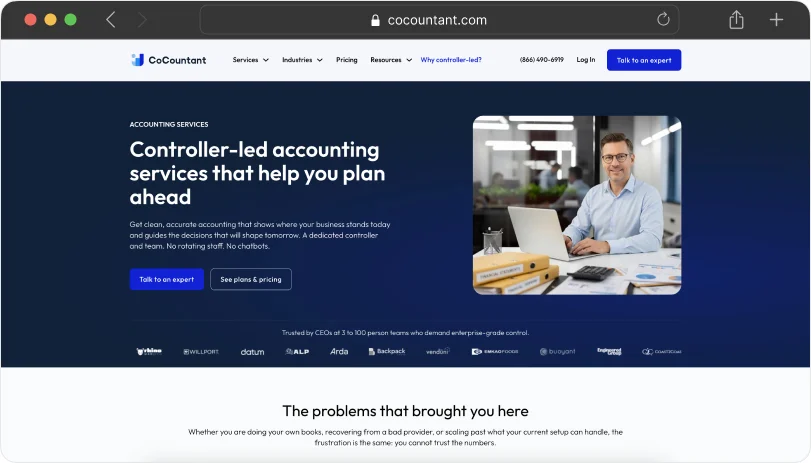
CoCountant pairs controller‑led accounting with FP&A support so leadership sees the full story, not just the statements. The close is structured, reconciliations are tight, and documentation is audit‑ready. Reporting comes with KPI narratives and budget versus actuals that board members can act on. For founders preparing for diligence or fundraising, the model reduces risk and speeds decisions.
Pricing
Starting from $160 per month.
Pros
- Controller leadership that tightens reconciliations and speeds the close
- Board‑ready reporting and decision‑focused analysis
- Forecasting, scenarios, and cash runway planning included
- Documentation that keeps audits and diligence calm
- Grows with you without forcing an early ERP move
Cons
- Not suited to teams looking for software only
Best for
Startups preparing for fundraising, board scrutiny, or audit readiness.
2) Decimal

Overview
Decimal emphasizes standardized, documented workflows across recurring finance tasks. This playbook approach creates predictability and reduces variance from month to month. It is designed for teams that want reliable execution without building internal processes. As needs expand, you can add capabilities, though strategy usually sits outside the core.
Pricing
Public plans commonly start around $299 per month and go to $679 per month for more robust packages; fractional CFO is custom.
Pros
- Clear, predictable processes month to month
- Useful for teams that value operational rigor
Cons
- Controller‑level guidance may be limited by plan
- FP&A and scenario planning typically require add‑ons
Best for
Process‑driven teams that want dependable execution without building it in‑house.
3) Acuity

Overview
Acuity provides operational bookkeeping with milestone‑based handoffs, plus optional tax and CFO support. The service meets you at your stage, from essentials to established, and can scale into heavier oversight as investors, banks, or boards require GAAP depth. Weekly bookkeeping and recurring reviews keep momentum. It’s a fit when you want a single team to cover more ground.
Pricing
Bookkeeping published at $479 per month to start; Bookkeeping Plus at $1,029 per month; full accounting packages around $2,179 per month depending on stage and services.
Pros
- Clear responsibilities and timelines
- Weekly bookkeeping with upgrade paths to CFO and tax
Cons
- Complex accruals, consolidation, and bespoke policy may need custom scope
Best for
Businesses with straightforward bookkeeping needs that may layer on CFO support.
4) Bookkeeper.com

Overview
Bookkeeper.com bundles bookkeeping and payroll so owners can streamline vendor management. The firm focuses on steady month‑end deliverables and turnkey payroll administration. While controller‑level guidance is usually a custom request, the one‑provider model appeals to teams that want to simplify operations. It is a practical option for small businesses that prefer fewer moving parts.
Pricing
Uses a pricing calculator rather than fixed public tiers; SMBs typically land in the low‑ to mid‑hundreds per month depending on volume and add‑ons.
Pros
- One‑vendor convenience for bookkeeping and payroll
- Steady monthly deliverables
Cons
- GAAP nuance and controller oversight are typically custom
- FP&A depth often requires additional engagement
Best for
Small businesses that want bookkeeping and payroll together with minimal vendor sprawl.
5) Bench

Overview
Bench delivers a straightforward, hands‑off bookkeeping service built for very small teams that want simplicity over complex controls. You get a dedicated bookkeeper who handles categorization and monthly statements, along with a clean app experience that keeps basics visible. It’s designed to keep you organized for tax time and year‑end packaging without a big lift from the founder. As needs grow into accrual complexity or multi‑entity reporting, you’ll likely need to add tools or upgrade services.
Pricing
Typical published prices of $299 or $499 per month depending on whether tax services are included in the plan.
Pros
- Easy month‑to‑month categorization and basic reporting
- Low lift for founders and solo operators
Cons
- Limited GAAP sophistication and accrual support
- No built‑in FP&A or controller review
Best for
Microbusinesses and solo operators that need straightforward bookkeeping.
Comparison table
| Solution | Category | Best for | Controller or CFO oversight |
| CoCountant | Outsourced accounting service | Startups preparing for fundraising, board scrutiny, or diligence | Included, controller‑led |
| Decimal | Outsourced bookkeeping | Process‑driven teams wanting predictable execution | Limited, varies by plan |
| Acuity | Outsourced bookkeeping | Businesses with straightforward processes and clear handoffs | Limited in core packages |
| Bookkeeper.com | Outsourced bookkeeping + payroll | Small businesses wanting one vendor for bookkeeping and payroll | Custom or limited by plan |
| Bench | Outsourced bookkeeping | Microbusinesses and solo operators | None |
How to choose the right alternative
Look at the next 12 to 18 months. Map needs, not just features.
- Define your close goals. Decide how fast you want to close each month and who owns approvals.
- List must-have integrations. Payroll, payments, subscriptions, inventory, and revenue recognition.
- Decide on oversight. Confirm whether you want controller leadership or a software-only approach.
- Align on FP&A. Make sure forecasts, scenarios, and KPI reporting are part of the engagement, not an afterthought.
- Model total cost. Include software, services, add-ons, and internal time.
Final recommendation: CoCountant
CoCountant delivers controller-led bookkeeping with a practical FP&A partnership. You get the discipline of a controller, the hygiene of a well-run close, and reporting your board will actually use. The model is simple. Accountants own the books. A controller reviews and enforces policy. FP&A connects actuals to your operating plan. You get clarity, compliance, and a decision-ready view of the business.
What you get with CoCountant
- Controller leadership that sets policy, enforces the close, and keeps reconciliations tight.
- Investor-grade reporting that covers GAAP financials, KPI narratives, and budget versus actuals.
- FP&A support that includes forecasting, scenario planning, and cash runway views.
- Compliance-first documentation that keeps diligence calm.
- A growth path that stretches further before you need an ERP, so you avoid an early, expensive migration.
Ideal for SaaS startups, venture-backed companies, and tech-enabled SMBs that want accurate books plus planning support in one relationship.
Not for do-it-yourself teams looking for software only.
FAQs
What are the best inDinero alternatives for startups in 2026?
The best inDinero alternatives for startups are platforms that combine reliable bookkeeping with proactive financial guidance. Services like CoCountant, Pilot, and Bench are commonly compared because they support growing businesses with different levels of oversight, pricing flexibility, and scalability. The right choice depends on whether your startup needs basic bookkeeping or controller-led insights as it grows.
Why do startups switch from inDinero to alternative accounting services?
Startups often explore alternatives to inDinero as transaction volume increases or reporting needs become more complex. Common reasons include rising monthly costs, limited strategic context in reports, and the need for faster closes with clearer explanations. Many founders prefer accounting partners that offer predictable pricing and ongoing financial guidance rather than reactive support.
How do I choose the best accounting platform for my startup?
When evaluating the best accounting platforms for startups, focus on three factors: level of oversight, scalability, and cost transparency. Early-stage startups may only need clean books, while growing teams benefit from controller review, cash-flow analysis, and runway planning. Comparing features, pricing, and review sentiment helps ensure long-term fit.
Are bookkeeping services enough for a growing startup?
Basic bookkeeping is often sufficient at the earliest stage, but as revenue grows, startups typically need more than categorized transactions. Top bookkeeping services for growing businesses usually include controller review, financial analysis, and guidance on margins and spending. This added layer helps founders make faster, more confident decisions.
How much do inDinero alternatives typically cost?
Pricing for inDinero alternatives for startups varies widely depending on service depth. Entry-level bookkeeping support may start under $200 per month, while managed accounting and advisory services can cost significantly more. Many startups look for solutions that balance affordability with strategic value as they scale.
What’s the difference between startup accounting software and managed accounting services?
Startup accounting software focuses on tools for recording and organizing financial data, while managed accounting services provide human expertise alongside the systems. In 2026, many startups prefer services that pair modern tools with controller-led oversight, ensuring both accuracy and actionable insight.
Is controller-led bookkeeping worth it for startups?
For startups planning to scale, controller-led bookkeeping can be highly valuable. It goes beyond compliance by explaining financial changes, identifying risks, and helping founders plan ahead. This approach is especially useful for startups comparing small business financial tools that support long-term growth rather than short-term reporting.